
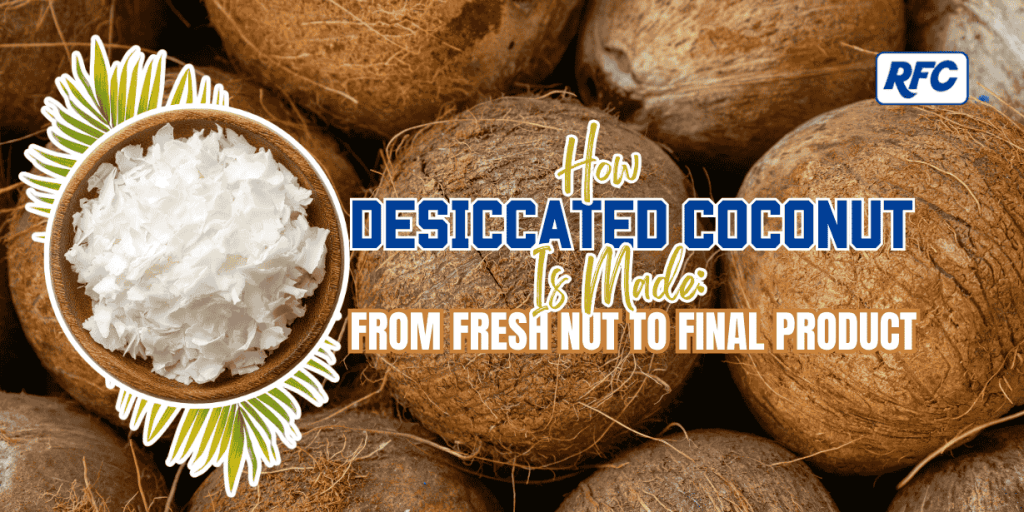
For food manufacturers and product developers, the value of an ingredient goes beyond its specifications on paper. Understanding how a product is made, the steps, the standards, and the controls involved, gives buyers the confidence to make informed sourcing decisions. This is especially true for desiccated coconut, a widely used ingredient in bakery, confectionery, snack, and health food applications.
From the selection of raw coconuts to the final packaged ingredient, every stage in the production process shapes the quality, safety, and consistency of what arrives at your facility. Here is a step-by-step look at how a skilled desiccated coconut manufacturer transforms fresh coconuts into a finished, food-grade product.
Step 1: Selecting and Harvesting the Right Coconuts
Quality in desiccated coconut production begins long before processing starts. The selection of raw materials is a foundational step. Mature coconuts, typically harvested at 11 to 12 months, yield white kernels with the right fat content, firmness, and flavor profile for desiccation. Coconuts that are too young or past peak maturity produce inferior kernels that affect both yield and taste.
Sourcing from trusted farming regions, where growing conditions are consistent and agricultural practices are reliable, helps maintain the standard of the raw material entering the production line.
Step 2: Dehusking, Shelling, and Paring
Once harvested coconuts arrive at the processing facility, they undergo a series of preparatory steps. The fibrous outer husk is removed first, followed by cracking the hard inner shell to expose the white kernel. The brown skin or “testa” is then carefully pared away from the kernel’s surface.
This paring stage is critical for producing a clean, bright white desiccated coconut. Any residual brown skin affects the appearance and can introduce off-flavors. Facilities operating under strict food safety protocols ensure that equipment is sanitized and that this step is performed under hygienic conditions.
Step 3: Grating or Shredding the Coconut Kernel
The pared white kernel is then mechanically processed into the desired particle form. Depending on the end application, this can result in fine, medium, or coarse grades, as well as shredded, flaked, or chip-style cuts. The choice of grade affects texture, visual appearance, and how the ingredient behaves in a formulation.
A well-equipped coconut processing facility maintains multiple cutting configurations to serve the diverse needs of food manufacturers, from fine desiccated coconut used in coatings and fillings to coarser shreds used in granola bars and trail mixes.
Step 4: Drying — The Critical Stage in the Process
Drying is the defining step in desiccated coconut production. The shredded or grated coconut is passed through a controlled drying system that reduces moisture content to a precise level, typically below 3 percent to ensure shelf stability and inhibit microbial growth.
The drying temperature, airflow, and duration must be carefully managed. Excessive heat can alter the natural fat content and cause discoloration or off-flavors, while insufficient drying leaves residual moisture that reduces shelf life. Moisture-controlled drying under monitored conditions is what separates a consistent, food-grade ingredient from a variable one.
Step 5: Sieving, Quality Testing, and Packaging
After drying, the product passes through sieving equipment to remove oversized or undersized particles and ensure uniformity across the batch. This step is followed by quality control testing, which may include checks for moisture content, microbial load, fat content, color, and particle size distribution.
Product that meets specification is then packaged under hygienic conditions in appropriate bulk formats, such as poly-lined sacks or food-grade bags, ready for shipment. Proper packaging preserves product integrity during transit and storage, protecting the quality that was built through every preceding step.
Each stage in the production process reflects the manufacturing standards and attention to detail that define a dependable coconut ingredient supplier. From raw coconut selection to final packaging, quality is not introduced at one single point, it is maintained throughout.
Royce Food Corporation applies this discipline across its full range of desiccated coconut products, producing ingredients that meet the requirements of global food manufacturers across bakery, confectionery, snack, and health food sectors. Our processing capabilities and commitment to consistent quality make us a trusted partner for businesses that demand reliability in their supply chain.
To learn more about our desiccated coconut products or to discuss your sourcing requirements, contact us today. You can also visit our blog for more insights on coconut ingredients and food production.